
alternatifbusiness
Business collaboration on financial charts and dat

Home / Resources / Prompt library / Finance & accounting

Prompt library · By profession

Finance & accounting prompts

10 detailed, ready-to-use prompts: budgets, cash flow, reports and financial analysis. Each prompt explains when to use it, what to replace and an expert tip. They work with ChatGPT, Claude, Gemini, Copilot and other assistants.

10 prompts

FIN-01

Monthly figures explained

When to use it: Explain numbers to a non-specialist.

Explain these monthly figures to a small business owner in plain language: [paste]. Highlight the 3 most important changes, one risk and one opportunity, and suggest 2 actions. No jargon, under 250 words.
Replace before use

[paste]

Expert tip

Paste figures for at least two periods.

FIN-02

Cash-flow forecast

When to use it: Anticipate cash shortages.

Build a 12-month cash-flow forecast structure for [business]. Revenue assumptions: [list]. Fixed costs: [list]. Variable costs: [list]. Payment delays: [days]. Give the table structure with formulas I can use in a spreadsheet, and highlight months where cash may fall below [threshold].

Replace before use

[business][list][days][threshold]

Expert tip

Update the forecast every month with actuals.

FIN-03

Budget with scenarios

When to use it: Plan a budget with prudent, expected and optimistic cases.

Create an annual budget for [business] with three scenarios (prudent, expected, optimistic). Inputs: [sales, prices, costs]. For each scenario: revenue, costs by category, margin and break-even point. Explain the assumptions behind each.

Replace before use

[business][sales, prices, costs]

Expert tip

Base the expected case on last year's real numbers.

FIN-04

Pricing and margin check

When to use it: Check whether a price is profitable.

Check the profitability of [product/service] priced at [price]. Costs: [materials, tools, time, fees, taxes]. Calculate gross margin, net margin, break-even volume and effective hourly rate. Suggest a price range and explain the trade-offs.

Replace before use

[product/service][price][materials, tools, time, fees, taxes]

Expert tip

Include your own time at a realistic hourly rate.

FIN-05

Invoice reminder emails

When to use it: Get paid without damaging the relationship.

Write 3 payment reminder emails for invoice [number] of [amount] due on [date]: day 7 friendly, day 14 firm, day 30 final before further steps. Each under 100 words, polite, with payment details placeholders.

Replace before use

[number][amount][date]

Expert tip

Send reminders on fixed days after the due date.

FIN-06

Expense categorisation

When to use it: Organise expenses for bookkeeping.

Categorise these expenses into standard small business categories and flag items that may need a receipt or special treatment: [paste list with dates, descriptions, amounts]. Output a table and a total per category.

Replace before use

Expert tip

Check the final categories with your accountant.

FIN-07

Investor or bank summary

When to use it: Present financials to a lender or investor.

Write a one-page financial summary of [business] for [bank / investor]. Include: activity, key figures for the last [period], funding needed and use of funds, repayment or return logic, risks and mitigations. Clear, factual, no exaggeration.

Replace before use

[business][bank / investor][period]

Expert tip

Use real figures and explain assumptions.

FIN-08

Variance analysis

When to use it: Understand gaps between budget and actuals.

Compare budget and actuals: [paste table]. Identify the 5 largest variances, likely causes, whether they are one-off or recurring, and the corrective actions. Present as a short table plus 5 bullet conclusions.

Replace before use

[paste table]

Expert tip

Focus on the largest variances first.

FIN-09

Unit economics

When to use it: Understand profit per customer.

Calculate the unit economics for [business]: average order value [x], gross margin [x], acquisition cost [x], purchases per year [x], retention [x]. Compute customer lifetime value, payback period and LTV/CAC, explain each in plain language and suggest improvements.

Replace before use

[business]

Expert tip

Use averages from the last 6 to 12 months.

FIN-10

Financial KPI dashboard

When to use it: Choose the numbers to track monthly.

Propose a monthly financial dashboard for [business type]: 8 key indicators with definition, formula, data source, target and alert threshold. Add the layout of a one-page spreadsheet dashboard.

Replace before use

[business type]

Expert tip

Fewer indicators, reviewed regularly, beat many ignored ones.

Always review AI output before using it, and never paste confidential or personal data into a tool without checking its data settings. Legal, financial and health outputs are general information, not professional advice.

More prompt categories

Keep exploring

Go further

Turn the idea into a business.

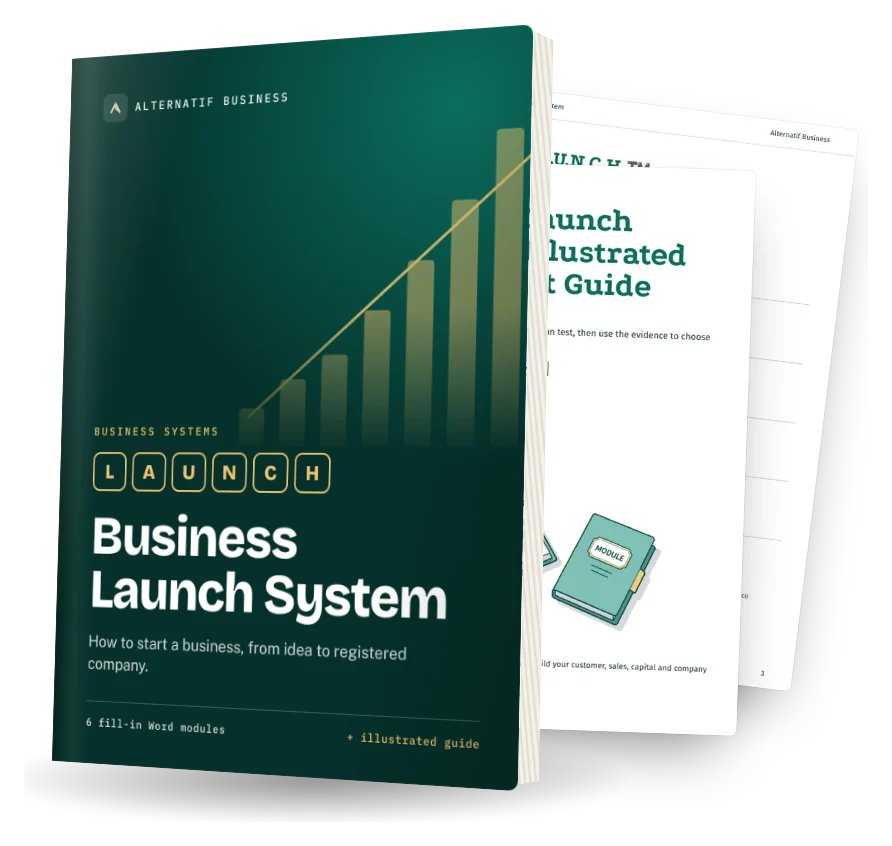
The Business Launch System helps you test it and set it up. The Self-Funding Client System helps you find clients. Both are fill-in Word systems.

Business Launch System cover: fill-in Word modules and illustrated quick-start guide